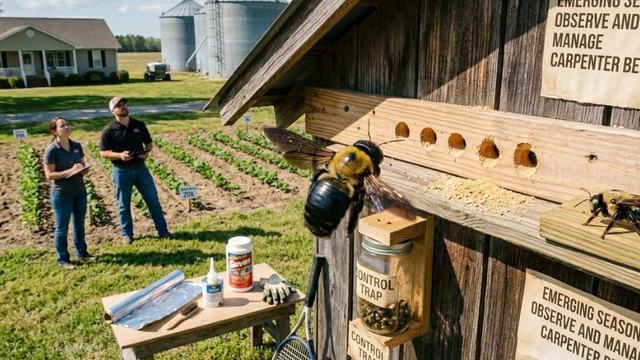
They’re back! Carpenter bees have started to emerge and begin their annual buzz around your house and outbuildings. Each year, adult male carpenter bees emerge first from hibernation and begin the task to attract their female counterparts. Both sexes overwinter as adults in old nest tunnels. The males can be distinguished from the females by the whitish spot on the front of their face. Males do not sting, however the females can sting, but generally only if they are confined in your hand or become highly agitated. Unlike honey bees or bumble bees, carpenter bees are solitary and do not form colonies with worker bees. The mated female feeds on plant nectar and then begins constructing new tunnels where she lays eggs and stores a food source (nectar mixed with pollen) for her offspring, often laying multiple eggs in the same tunnel. They do aid in pollination, so that is a positive for them. The tunnels are about one-half inch in diameter and 6-7 inches long, although they may be as long as a foot if the same tunnel is used in successive years. The adults die in a matter of weeks, and the new generation begins to emerge in late summer. The new generation remains active, feeding on pollen in the area, but do not create new tunnels. Rather, they may be seen cleaning out the old tunnels, which they use to overwinter when the weather turns cold.
Control is difficult to say the least. Burrowing into the wood protects them from most insecticide applications except treatments to each individual tunnel and then sealing the tunnel after 2-3 days. Products such as Sevin or bifenthrin work well and are labelled for homeowner use. Follow the label directions and treat inside the tunnel with a dust or liquid formulation, wait 2-3 days, and then seal the tunnel with aluminum foil, steel wool or caulk. Non-pesticide deterrent methods include painting or staining the exposed wood. They like untreated wood best. There are also several versions of traps available and work reasonably well. Install the trap close to the affected wood and active carpenter bees. Finally, some homeowners have had some success with a paper bag stuffed with plastic bags to give it volume, and hung close to where the bees are attempting to tunnel. The assumption is the carpenter bees feel threatened by the presence of what they think are wasps or hornets, and the bag represents their nest. As a last attempt, you may have some luck swatting them with a tennis racket. This is not often very effective, but it gives a lot of satisfaction to the homeowner!